Something quietly historic is happening on Britain’s railways, and this week it became visible for the first time. On 21 May 2026, the first Great British Railways-branded train was unveiled in Brighton – a Southern Class 387 wearing a fresh red, white and blue livery. It is a small change in one sense, a coat of paint on a single train, but it is the first thing passengers can actually see of a reform that will reshape how the entire network is run. For anyone who loves maps, follows the railways, or simply wants an accurate picture of how Britain travels, it is a good moment to pay attention.
What is Great British Railways?
Great British Railways, usually shortened to GBR, is a new publicly owned body that will bring the management of passenger train services and the rail infrastructure together under a single organisation. For roughly thirty years, Britain’s railway has been split between Network Rail, which looks after the track, and a long list of separate private train operators, which ran the services. That fragmentation has often been blamed for confusion, duplication and a system that could be difficult for passengers to navigate. GBR is designed to act as a single guiding mind for the railway, responsible for planning the network, running services, managing stations and depots, and setting most fares and timetables. The Railways Bill currently moving through Parliament will give GBR its full legal footing, and the new body is expected to be fully established by the end of 2027.
Which train operators have been nationalised?
The shift to public ownership is happening operator by operator, as existing private contracts expire, rather than all at once. South Western Railway was the first to transfer, in May 2025, followed by c2c, Greater Anglia, Northern, TransPennine Express, Southeastern, LNER and, in February 2026, West Midlands Trains. The next milestone is a significant one. On 31 May 2026, Govia Thameslink Railway – Britain’s largest train operator, covering Thameslink, Great Northern, Southern and Gatwick Express – joins the publicly owned network. Once that happens, around eight in ten passenger rail journeys will take place on publicly owned services, with more than 11,000 publicly owned services running each weekday. Chiltern Railways is scheduled to follow on 20 September 2026, and Great Western Railway on 13 December 2026, with the full programme expected to be complete by the end of 2027.
Why this matters if you love maps
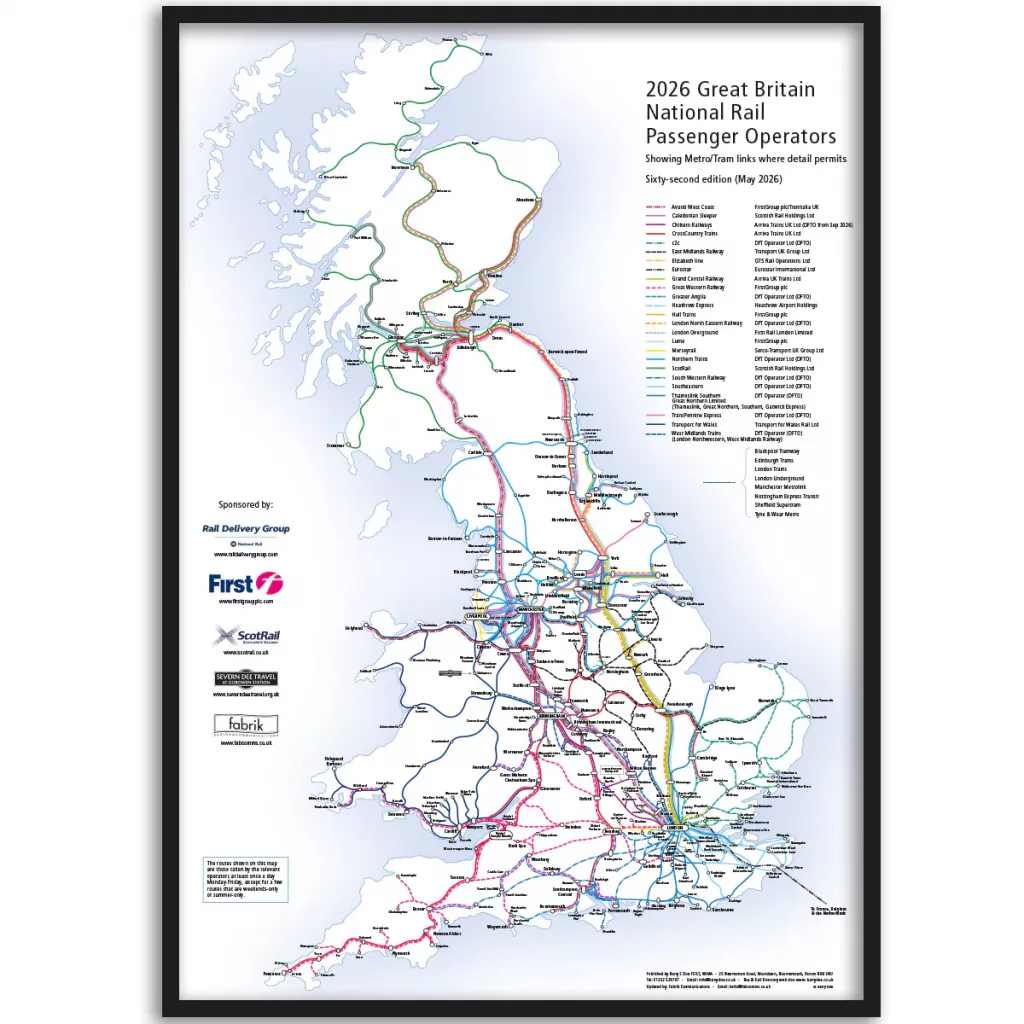
Here is the part that fascinates us at MapShop. A rail network is never truly finished – it is always being adjusted, extended and renamed – but it is rare to watch the organising structure behind the whole system change so fundamentally and so quickly. The lines on the map are not moving, but the identity stitched across them is. Branding, fares, timetables and accountability are all being pulled together under one name for the first time in a generation. That makes a printed network map from this period genuinely interesting: it is a snapshot of a railway captured mid-transition, on the cusp between the privatised era and the GBR era. The maps that document moments of change are often the ones that become the most collectable later.
A reliable picture of the network as it stands
Whether you are a daily commuter, a planner, a teacher, a rail enthusiast or simply someone who likes a handsome wall map, there is real value in having an accurate, up-to-date overview of the network. Our UK Railway Network Map 2026 is the 61st edition of this long-running map and shows every National Rail passenger operator and route across England, Scotland and Wales, alongside tram and urban metro networks. It is printed on demand on semi-glossy, FSC-certified or equivalent sustainable paper, with free shipping in the UK. As the operators behind those routes move into public ownership through 2026 and beyond, a clear map of the lines themselves remains the steady reference point – the thing that helps the changes make sense.
The takeaway
The unveiling in Brighton was described by the Transport Secretary as making the future of Britain’s railways a reality, and as more than just a paint job. For passengers, the practical change arrives gradually, station by station and operator by operator. For anyone who appreciates cartography, it is a reminder that maps are not just travel tools – they are records of a particular moment in time. Right now, that moment is an unusually interesting one.
Explore the UK Railway Network Map 2026 and our full range of rail and transport maps at MapShop, with free UK shipping.