
As the NHS continues to evolve, understanding healthcare geographies across England has become increasingly important. For many healthcare professionals, planners, and commissioners, one term now appears frequently in reports, meetings, and strategy documents: the ICB map.
In this blog post, we explain what an ICB map is, why it matters, and how it supports effective planning and decision-making across the NHS.
What is an ICB?
Integrated Care Boards (commonly known as ICBs) were introduced as part of NHS reforms to bring health and care organisations closer together. Each ICB is responsible for planning and commissioning NHS services for a defined population, working in partnership with local authorities, NHS trusts, primary care providers, and voluntary organisations.
ICBs replaced Clinical Commissioning Groups (CCGs) and now form the backbone of how healthcare services are planned, funded, and delivered across England.
What is an ICB map?
ICB maps provide a clear, visual representation of the boundaries of England’s Integrated Care Boards. It shows how the country is divided into NHS commissioning areas, helping professionals understand where responsibility for services begins and ends.
This type of healthcare map offers far greater clarity than written lists or spreadsheets, which can often be difficult to interpret and maintain. You may see them sometimes referred to as an NHS map, as they reflect the current organisational structure of NHS England.
Why are ICB maps important?
Healthcare delivery is actually closely tied to geography. Whether planning services, analysing population health data, or coordinating care across organisations, understanding boundaries is key.
An up-to-date ICB map supports healthcare professionals in numerous ways, including:
- Clearly showing current NHS commissioning boundaries
- Supporting informed planning and commissioning decisions
- Helping teams align services across neighbouring areas
- Improving communication between organisations and stakeholders
Beyond this, visualising NHS boundaries also plays a much broader strategic role. It helps teams understand how system level decisions affect local services, populations, and partnerships. By showing the relationships between individual ICBs, clusters, and regions at a glance, it makes NHS structures easier to interpret and explain, particularly during periods of rapid organisational change.
ICBs, clusters, and changing NHS geography
To improve efficiency and reduce duplication, many ICBs are now working within clusters. These arrangements allow multiple ICBs to share leadership teams and resources while remaining separate legal entities.
However, clustering can also introduce additional complexity into NHS geography. A clear ICB map helps professionals understand how individual boards relate to clusters, NHS regions, and surrounding systems, especially as mergers and boundary changes are expected over the coming years.
Who uses ICB maps?
A wide range of organisations and professionals across the healthcare sector take advantage of these maps, including:
- NHS commissioners and planners
- Public health teams
- Local authorities
- Health analysts and researchers
- Consultancy and strategy teams
- Training and education providers
They are particularly useful in meetings, reports, presentations, and operational planning, where clarity, accuracy and consistency are imperative.
MapShop’s UK Integrated Care Boards Map
To support professionals working in this space, MapShop offers a dedicated UK Integrated Care Boards (ICB) Map. This detailed England commissioning map reflects the latest NHS structure and boundary data, based on official releases from April 2023.
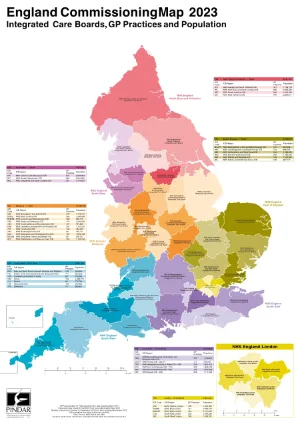
The map clearly displays all ICB boundaries across England, colour coded by NHS England region. It also includes Sustainability and Transformation Partnership and former Clinical Commissioning Group boundaries for additional context.
Available as A1 or A2 poster formats, as well as JPEG and PDF digital files, it’s designed for practical use in offices, meeting rooms, and presentations.
As Integrated Care Boards continue to shape the future of healthcare delivery in England, having a clear, accurate, and up-to-date ICB map isn’t just helpful, it’s essential.
If you’d like to discuss how MapShop can support your mapping needs, please get in touch and let us know your requirements.
